
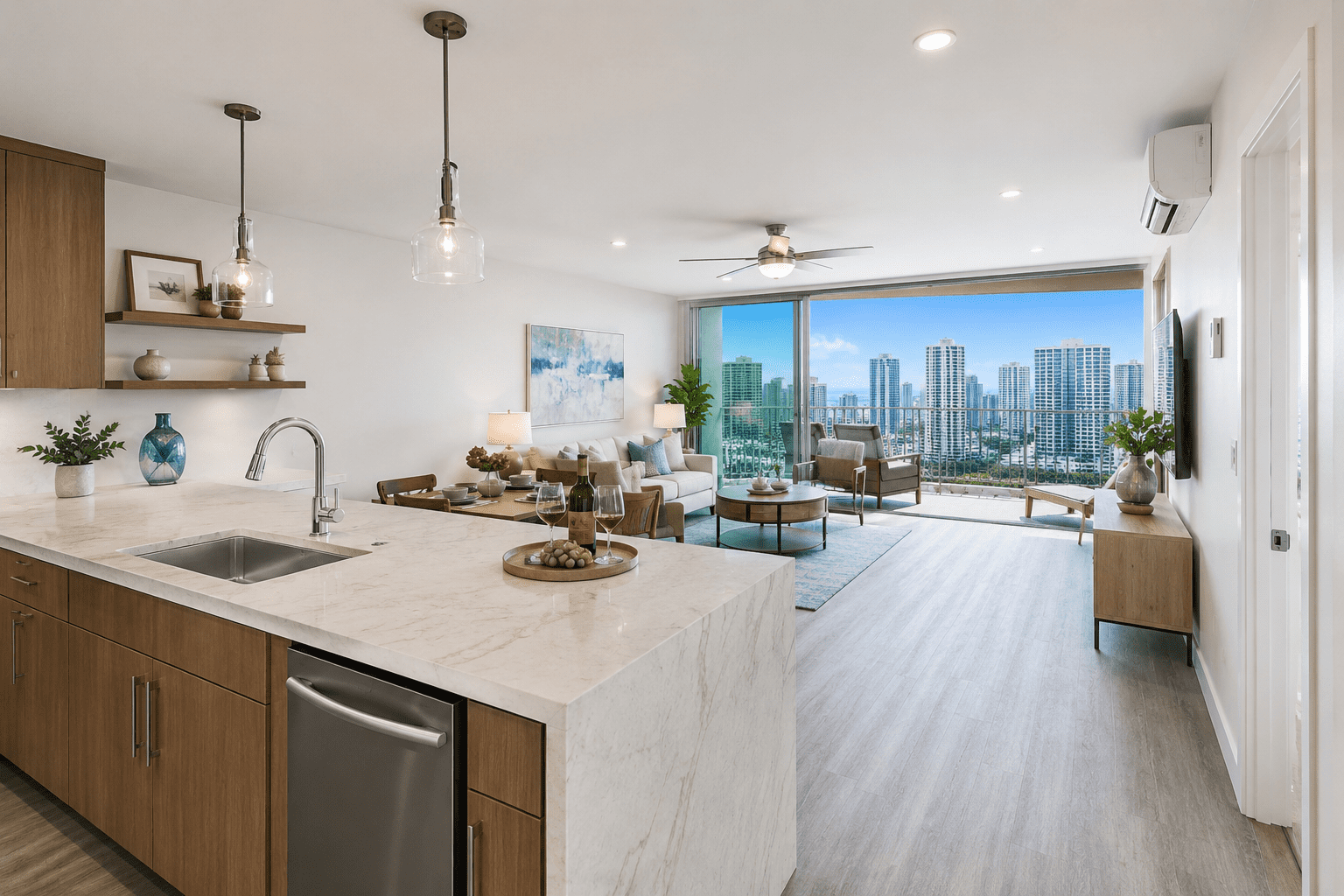
Quick take: A stress-free home renovation comes from one thing: planning the work in the right order before any demo starts. Follow the eight steps below and most of the surprises that derail Hawaii projects never happen.
Most of the stress in a home renovation comes from decisions made too late, not the work itself. Materials ordered after demolition starts. Permits requested after the contractor arrives. Stone slabs picked after the cabinets are installed. Each one is fixable, but each one stretches the timeline and the budget.
This step-by-step guide walks through how to plan a Hawaii home renovation the way our team plans them, so the project lands on time and on scope. We’ll also show how the Ohana Package takes most of the coordination off your plate.
Why a Step-by-Step Approach Matters
National data from the NAHB Remodeling Market Index and the Houzz U.S. Renovation Trends Study consistently rank kitchens, bathrooms, and flooring as the highest-impact home renovation projects.
By the numbers:
- Roughly 1 in 10 U.S. homeowners renovate a kitchen each year (Houzz Kitchen Trends Study)
- A mid-range kitchen renovation returns 70% to 80% of its cost at resale (Remodeling Magazine Cost vs. Value)
- A bathroom renovation returns 60% to 70% at resale
- Hawaii ranks among the top states for renovation spend per household, driven by tight inventory and aging building stock
Those numbers tell you the upside is real. The home renovation projects that capture that upside are the ones that follow a clear plan from day one.
The 8-Step Stress-Free Home Renovation Plan
Here is the eight-step home renovation framework we use on every project.
Step 1: Define Your “Why” Before Your “What”
Before you choose finishes, write down what you want this home renovation to accomplish. The honest answer drives every other decision.
Common answers we hear:
- Make the unit more livable for daily life
- Lift resale value before listing
- Improve short-term or long-term rental performance
- Replace finishes that are failing or outdated
- Open up the layout for entertaining
Pick the top one or two reasons. Every later trade-off should serve them.
Step 2: Set a Realistic Scope and Budget
A scope that’s too broad is the most common reason a home renovation runs over. Decide which rooms are in scope and which are off-limits, then commit.
A few practical rules:
- Group projects by trade. Doing both bathrooms together is cheaper than doing them six months apart.
- Keep a 15% to 20% contingency. Hawaii projects often surface surprises behind the walls.
- Decide what you’re keeping. Existing cabinet boxes, fixtures, and flooring you can reuse cut both cost and timeline.
Step 3: Lock the Layout Before Picking Finishes
The most expensive home renovation mistake is choosing finishes before finalizing the layout. Cabinet sizes, appliance dimensions, and plumbing locations dictate what’s even possible. Lock the floor plan first.
Step 4: Choose Materials Early
In Hawaii, lead times to the islands stretch every project. The earlier you select stone, tile, and flooring, the better the schedule holds. Browse our natural stone collection and flooring options to start narrowing down.
Step 5: Confirm Permits and HOA Rules
Every Hawaii home renovation runs into one or both of these. Cosmetic-only updates usually don’t require permits. Anything that touches plumbing, electrical, structural elements, or shared walls usually does. Submit early.
Step 6: Sequence the Trades
The single biggest source of delay in a home renovation is trades arriving in the wrong order. The right sequence:
- Demolition
- Rough plumbing and electrical
- Insulation and drywall
- Flooring substrate and tile
- Cabinetry
- Stone counters
- Plumbing and electrical trim
- Paint, fixtures, and final detail
Skip a step and the work behind it has to come back out.
Step 7: Schedule Around Real-World Constraints
In Hawaii, this means HOA noise hours, elevator reservations, neighbor notice, and shipping windows for materials moving by sea. Build the home renovation calendar around these constraints, not around them.
Step 8: Inspect and Punch List Before Final Payment
The last 5% of a home renovation is where quality is won or lost. Walk every surface, every drawer, and every fixture before signing off. Document anything that needs touch-up in a written punch list, with dates.
At-a-Glance: Home Renovation Timeline by Project Type
| Project | Typical Duration | Notes |
|---|---|---|
| Single bathroom | 4 to 8 weeks | HOA approval may add 2 to 4 weeks |
| Kitchen | 6 to 10 weeks | Cabinet lead times often drive the schedule |
| Whole condo | 10 to 16 weeks | Sequence trades carefully |
| Whole home | 16 to 24 weeks | Phase to keep livability |
Use this as a starting point. Every Hawaii home renovation has its own variables, including building rules, permit timelines, and material availability.
How the Ohana Package Makes a Home Renovation Stress-Free
This is where most homeowners hit friction. A typical home renovation involves a designer, a stone supplier, a flooring supplier, a cabinet maker, an installer, and a general contractor. Each one has their own schedule, their own pricing model, and their own level of attention to your project.
We built the Ohana Package to remove that friction. It bundles material selection, fabrication, and professional installation into a single streamlined experience designed around the way Hawaii projects actually run.
What’s Included
- Personalized design consultation with a Hawaii-based specialist
- Curated stone, tile, and flooring selection from in-island inventory
- Cabinet coordination with vetted local fabricators
- Precision stone fabrication in our local facility
- Professional installation by trained, in-house crews
- Permit and HOA documentation help when applicable
- One point of contact, with no chasing four subcontractors
Why it matters: A bundled home renovation removes the most common source of delays: handoffs between vendors who don’t talk to each other. That speed translates directly into fewer weeks of disruption and fewer surprises along the way.
Built for Hawaii Realities
The Ohana Package is shaped around what island projects actually face, including container shipping schedules, permit timelines that vary by county, HOA approvals for condo and townhouse owners, and the reality that some materials still ship by sea. We’ve delivered it for primary residences, vacation rentals, and full-estate renovations across Oahu and the neighbor islands.
If you’re not sure how your home renovation fits, schedule a free consultation. We’ll scope the project at no cost and come back with a clear plan within a few business days.
Common Home Renovation Mistakes to Avoid
Even careful homeowners trip over these:
- Starting demolition before materials are confirmed. Hawaii lead times mean a wall opens and then waits.
- Choosing finishes from tiny samples. Always view full-sized samples in your actual home lighting.
- Using mainland-spec materials. Porous stone, untreated wood, and certain grouts simply don’t last in island humidity.
- Hiring four separate vendors. Every handoff is a delay risk; bundled services like the Ohana Package solve it.
- Skipping the contingency. Plan for 15% to 20% overage on any older home renovation.
A great home renovation rewards planning. The homeowners happiest with their finished project are the ones who slowed down at the design phase and let their installer help select materials and sequence the work.
A single-room home renovation typically runs 4 to 10 weeks. A whole-condo project usually runs 10 to 16 weeks. A whole-home renovation runs 16 to 24 weeks or more, depending on scope.
Cosmetic updates like paint and fixtures generally don’t. Anything that touches plumbing, electrical, structural elements, or shared walls usually does. Each county has its own process.
Our team handles permitting for clients as part of the Ohana Package when it applies.
For a single bathroom or kitchen, most homeowners stay. For a full home renovation involving multiple rooms, plumbing, and dust-heavy work, moving out for the heaviest phases is often easier on the household and the schedule.
Plan for 15% to 20% contingency on any home renovation involving an older home. Hawaii’s age range of housing stock means walls and subfloors regularly surface conditions that weren’t visible at the planning stage.
The fastest path is to schedule a consultation. Bring rough measurements, inspiration photos, and a wishlist. We’ll walk through scope, talk timelines, and provide a clear plan before any work begins.
Plan Your Home Renovation With Confidence
A stress-free home renovation in Hawaii is built on the same foundation every time: a clear “why,” a locked layout, materials selected early, sequenced trades, and a single team coordinating every moving part.
The Ohana Package is the simplest way to put all of that on a single timeline with a single point of accountability.