Quick take: Kitchen cabinets are the single most expensive and most visible part of a kitchen remodel. The right cabinets last 20+ years, lift resale value, and stand up to Hawaii’s humidity. The wrong ones warp, swell, and date your kitchen before the next refinance.
If you’re planning a kitchen remodel, the cabinet decision matters more than any other choice you’ll make. Cabinets shape the entire feel of the space, define how you store and cook, and account for the largest line item in most renovation budgets.
This guide walks you through how to pick the right kitchen cabinets, what materials hold up in Hawaii, and how the Ohana Package ties cabinets, stone, and flooring together so the whole project lands cleanly.
Why Kitchen Cabinets Drive the Whole Remodel
National data from the NAHB Remodeling Market Index and the Houzz U.S. Renovation Trends Study consistently show kitchens at the top of every renovation priority list.
By the numbers:
- Roughly 1 in 10 U.S. homeowners renovate a kitchen each year (Houzz Kitchen Trends Study)
- Cabinets typically account for 30% to 40% of a full kitchen remodel project
- A mid-range kitchen remodel returns 70% to 80% of its cost at resale (Remodeling Magazine Cost vs. Value)
- Hawaii ranks among the top states for renovation spend per household, driven by tight inventory and aging building stock
The takeaway is simple. Kitchen cabinets are where the money goes, where the eye lands, and where Hawaii’s climate punishes shortcuts hardest.
What Buyers and Appraisers Look For
When buyers walk into a remodeled kitchen, three signals register immediately:
- Cabinet condition and style. Outdated finishes age the whole room.
- Counter material. Stone reads as quality.
- Layout flow. Cluttered or closed-off layouts hurt perceived value.
Choose kitchen cabinets that hit all three signals and the rest of the kitchen remodel does easier work.
Cabinet Materials: What Works in Hawaii
Material choice is the most consequential decision in your cabinet selection. Stock plywood from a big-box mainland retailer often warps within a few years in island bathrooms and kitchens. Plan accordingly.
At a Glance: Best Cabinet Materials for Hawaii
| Material | Best For | What to Watch |
|---|---|---|
| Marine-grade plywood | Cases, boxes, shelving | Slightly higher cost, worth it |
| Solid hardwood | Doors, drawer fronts | Needs sealed, moisture-resistant finish |
| Sealed MDF | Painted doors, panels | Confirm sealing on all six sides |
| Particleboard | Avoid in island kitchens | Swells fast in humidity |
| Thermofoil | Budget paint look | Heat near ovens can delaminate |
Plywood and Hardwood Carry the Day
For Hawaii kitchen cabinets, marine-grade plywood for the cabinet boxes and solid hardwood for the doors is the gold standard. The plywood resists moisture, holds screws indefinitely, and won’t bow under heavy stone counters. Hardwood doors take a beating gracefully and refinish well a decade in.
For more on materials that pair well with these kitchen cabinets, see our natural stone collection.
Painted MDF: Yes, With a Caveat
Painted MDF cabinet doors are popular for a reason. They give a smooth, modern look at a friendlier cost than custom hardwood. The catch is that MDF must be sealed on all six sides before paint, otherwise humidity finds the unsealed edges and the doors swell. Confirm this with your supplier in writing.
Cabinet Styles That Age Well
Kitchen cabinets fall into a handful of style categories. Picking one that ages well matters more than picking one that’s “trendy right now.”
Shaker
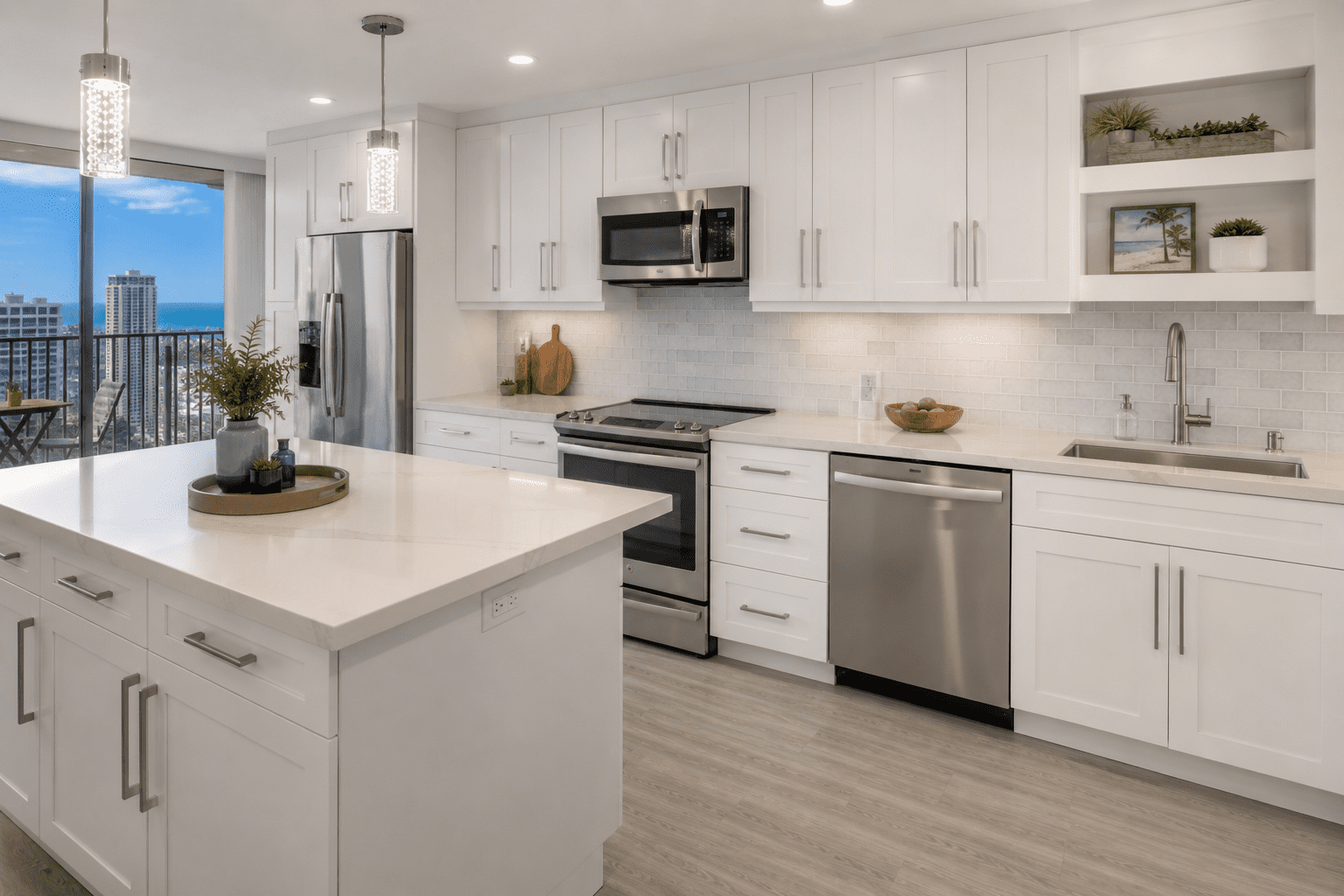
The most popular style of kitchen cabinets for a reason. Clean recessed-panel doors, simple lines, and a look that has held up across decades of design cycles. Shaker kitchen cabinets work in coastal, modern, traditional, and transitional kitchens.
Slab (Flat-Panel)
Modern, minimal, and increasingly common in Hawaii new builds. Best in hardwood veneer or sealed MDF with a high-quality finish. Slab kitchen cabinets show every imperfection in the door, so material quality matters more here than anywhere else.
Inset
The most premium build. Doors sit flush inside the cabinet frame instead of overlaying it. Beautiful and durable, but the precision required raises cost and lead time. Often a centerpiece of high-end Hawaii renovations.
Beadboard and Cottage
Charming for plantation-style or beach cottage homes. Use sparingly. These styles can date faster than Shaker or slab if applied across an entire kitchen.
Hardware, Finish, and the Details That Matter
Once you’ve chosen your cabinet material and style, the smaller decisions add up fast. These are the details that separate kitchen cabinets that feel custom from cabinets that feel catalog.
Soft-Close Hardware
Now standard on quality kitchen cabinets. Soft-close hinges and drawer slides protect cabinet doors and faces from slamming, dramatically extending the life of the finish.
Drawer Stack vs. Door-and-Shelf
Modern Hawaii kitchen cabinets lean heavily on drawer stacks for base units. They store more, access better, and put less strain on doors. Reserve doors for upper cabinets and pantry units.
Finish Type
Three primary options for kitchen cabinets:
- Stained hardwood for warmth and visible grain
- Painted finishes for crisp, modern color
- Natural oiled finishes for a soft, organic look that ages beautifully
Avoid heavy gloss finishes in beach-adjacent kitchens. They show salt spray and water spots within months.
Pulls and Knobs
Don’t underestimate hardware. Brushed nickel, matte black, and unlacquered brass all work well on Hawaii kitchen cabinets. Avoid raw brass or untreated copper near ovens and salt air.
How the Ohana Package Ties Cabinets, Stone, and Flooring Together
This is where most homeowners hit friction. Cabinets come from one vendor, stone counters from another, and flooring from a third. Each one has its own designer, lead time, and crew, and none of them naturally talk to each other.
We built the Ohana Package to remove that friction. It bundles material selection, fabrication, and professional installation into a single streamlined experience built around the way Hawaii projects actually run.
What’s Included
- Personalized design consultation with a Hawaii-based specialist
- Curated stone, tile, and flooring selection from in-island inventory
- Cabinet coordination with vetted local fabricators
- Precision stone fabrication in our local facility
- Professional installation by trained, in-house crews
- One point of contact, with no chasing four subcontractors
Why it matters: When kitchen cabinets, counters, and floors come from coordinated suppliers on a single timeline, you avoid the most common kitchen remodel delay: a stone slab that doesn’t ship until cabinets are set, then doesn’t fit because the cabinets shifted half an inch during install.
Built for Hawaii Realities
The Ohana Package accounts for what mainland vendors miss. Container shipping schedules, county permit timelines, HOA approvals for condo owners, and the reality that the right cabinet hardware sometimes has to ship by sea. Browse our flooring options to see materials we keep stocked locally for projects on tight timelines.
If you’re not sure how your project fits, schedule a free consultation. We’ll scope the work at no cost and come back with a clear plan within a few business days.
Common Cabinet Mistakes to Avoid
Even careful homeowners trip over these:
- Ordering cabinets before finalizing the appliance package. Fridge depths and range hood sizes drive cabinet dimensions.
- Skipping the seal on MDF doors. Confirm in writing that all six sides are sealed before paint.
- Choosing finish color in a showroom. Always view samples in your actual kitchen lighting before committing.
- Underestimating storage needs. Walk through your current kitchen and inventory what you store before designing.
- Hiring four separate vendors. Every handoff is a delay risk; bundled services like the Ohana Package solve this.
A great set of kitchen cabinets rewards planning. The homeowners happiest with their kitchen remodel are the ones who slowed down at the design phase and let their installer help select materials.
Cabinets typically account for 30% to 40% of a full kitchen remodel, making them the largest single line item. Material choice, finish complexity, and whether the cabinets are stock, semi-custom, or fully custom drive the range. We’ll walk through specifics during your consultation.
Marine-grade plywood boxes paired with solid hardwood doors are the longest-lasting choice for Hawaii kitchens. Sealed MDF painted doors also perform well when sealed on all six sides. Avoid particleboard cases in any humid kitchen.
If the cabinet boxes are solid plywood and the layout still works, refacing or refinishing can save weeks and stretch your budget further. If the boxes are particleboard or the layout no longer fits how you cook, replacing is the better long-term call. Our team will assess your existing kitchen cabinets at no cost.
Stock cabinets can arrive in two to four weeks. Semi-custom typically runs six to eight weeks. Fully custom kitchen cabinets can take 10 to 16 weeks, with shipping to the islands often adding two to four weeks on top.
Yes. The Ohana Package flexes to the scope you need. We can coordinate kitchen cabinets, stone counters, and flooring as a bundle, or focus on a single piece of the project.
Choose Your Kitchen Cabinets With Confidence
The right kitchen cabinets do three things at once: they look beautiful, they survive Hawaii’s climate, and they fit how you actually cook and live. Hit all three and the rest of your kitchen remodel falls into place.
The simplest way to lock that in is to put your kitchen cabinets, stone counters, and flooring on a single coordinated timeline. That’s exactly what the Ohana Package is built for.