
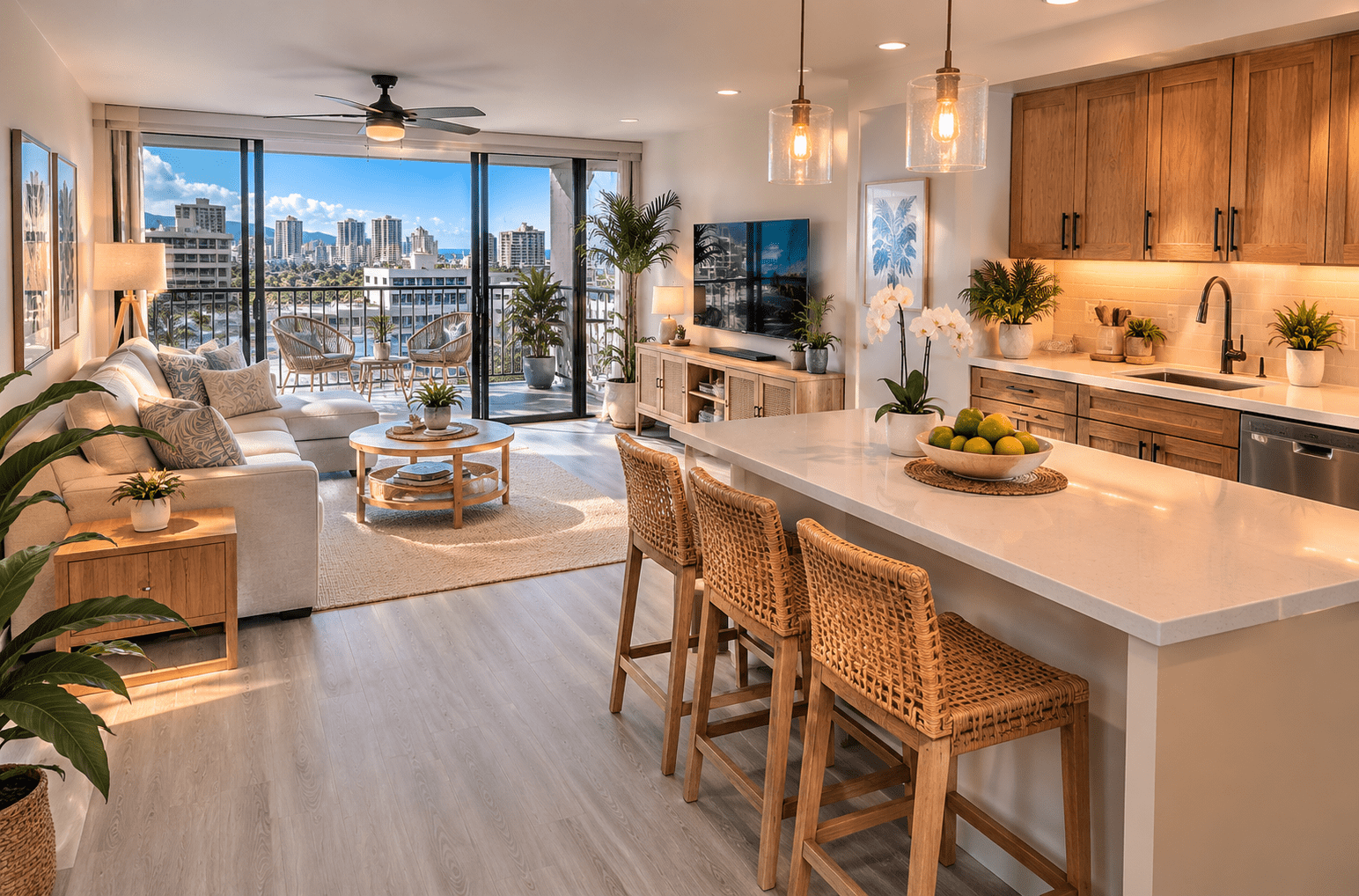
Quick take: Condo flooring in Hawaii has to handle humidity, sand, salt air, sliding-door traffic, and the occasional water leak. The three categories below cover almost every Hawaii condo renovation we touch.
Choosing the right condo flooring is one of the most consequential decisions in any Hawaii renovation. Floors take more wear than any other surface, they cover more square footage than any other material, and they shape how the unit feels the second a buyer or renter walks in.
This guide compares the best condo flooring options for Hawaii, where each one shines, and how the Ohana Package keeps selection, fabrication, and installation under one roof.
Why Condo Flooring Matters More in Hawaii
National data from the NAHB Remodeling Market Index and the Houzz U.S. Renovation Trends Study consistently rank flooring among the top three upgrades that lift resale value.
By the numbers:
- Roughly 1 in 10 U.S. homeowners renovate a kitchen each year (Houzz Kitchen Trends Study), and flooring is almost always part of the project
- Updated flooring is one of the top three features buyers cite when comparing comparable condos
- Hawaii ranks among the top states for renovation spend per household
- Premium condo flooring drives higher short-term rental rates for owners renting their units
Beyond the numbers, condo flooring is the single largest visual surface in a unit. Get it right and the entire condo reads as more polished. Get it wrong and even great cabinetry and counters fall flat.
The Three Best Condo Flooring Categories
Hawaii condos thrive on three flooring categories. Each has a place. Knowing which is right for your unit comes down to humidity, traffic, layout, and HOA rules.
Porcelain Tile
The workhorse of condo flooring in Hawaii. Porcelain is essentially waterproof, almost impossible to scratch, and available in finishes that mimic wood, stone, or concrete. Large-format porcelain tile is especially good in small condos because fewer grout lines make the floor read larger.
Natural Stone
For owners who want a higher-end finish, sealed natural stone is the choice. Quartzite, granite, and certain marbles all perform beautifully in island conditions when sealed correctly. They warm a space, age with character, and feel substantial underfoot. Browse our natural stone collection for slabs we keep in island inventory.
Premium Luxury Vinyl Tile (LVT)
Modern premium LVT is the surprise winner of the last few years. It’s waterproof, quiet underfoot, easier on the joints than tile or stone, and HOA-friendly because most products meet the sound transmission ratings condo associations require.
How the Three Compare
| Feature | Porcelain Tile | Natural Stone | Premium LVT |
|---|---|---|---|
| Water resistance | Excellent | Good (with seal) | Excellent |
| Durability | Excellent | Excellent | Very Good |
| Comfort underfoot | Firm | Firm | Soft |
| Sound rating (condo) | Needs underlayment | Needs underlayment | Often pre-rated |
| HOA approval ease | Common | Common | Easiest |
| Aesthetic | Modern, versatile | Premium, warm | Wood-look options |
Choosing the Right Condo Flooring for Your Unit
The right condo flooring choice depends on your unit, your usage, and your HOA’s rules.
If You Live There Year-Round
If the condo is your primary residence, prioritize comfort and longevity. Premium LVT or large-format porcelain tile are both strong choices. Sealed natural stone works beautifully in entry, kitchen, and bathroom zones if you want a higher-end finish.
If You Rent Short-Term
For Airbnb and VRBO units, condo flooring durability is the priority. Porcelain tile and premium LVT both stand up to constant turnover better than hardwood or carpet. They’re also easier to clean between guests and resist the sand and water that come through every door in Hawaii.
If You Rent Long-Term
For long-term rentals, look for condo flooring that resists wear and is easy to repair. Premium LVT is often the right choice because individual planks can be replaced without redoing the whole floor.
HOA Considerations
Most Hawaii condo associations have rules about sound transmission. Floors above other units typically require an underlayment that meets a specific IIC and STC rating. Confirm these numbers with your HOA before ordering condo flooring. Browse our flooring options for products that already meet most building requirements.
How the Ohana Package Simplifies Condo Flooring Installation
This is where most owners hit friction. Sourcing the floor is one step. Coordinating the fabricator, installer, HOA approval, and elevator reservation is four more, and they don’t naturally happen at the same speed.
We built the Ohana Package to remove that friction. It bundles condo flooring selection, complementary stone work, and professional installation into one streamlined experience.
What’s Included
- Personalized design consultation with a Hawaii-based specialist
- Curated condo flooring selection from in-island inventory
- HOA documentation help for sound and material approvals
- Precision stone fabrication for paired counter or tile work
- Professional installation by trained, in-house crews
- One point of contact, with no chasing four subcontractors
Why it matters: A bundled approach to condo flooring removes the most common cause of delays: handoffs between vendors who don’t talk to each other. In a condo, where elevator reservations, noise hours, and HOA review all compress the schedule, that speed translates directly into fewer days of disruption.
Built for Condo Owners
The Ohana Package is shaped around what condo owners actually face. We’ve delivered it on Oahu and across the neighbor islands for primary residences, vacation rentals, and full-floor renovations. If you’re not sure how your project fits, schedule a free consultation.
Common Condo Flooring Mistakes to Avoid
Even careful owners trip over these:
- Skipping the HOA sound spec. Many buildings require IIC 50 or higher; a non-rated floor can be ripped out at owner expense.
- Choosing finishes from a tiny sample. Always view full-sized condo flooring samples in your actual unit lighting.
- Using mainland-spec materials. Porous stone and untreated wood don’t last in island humidity.
- Ignoring transitions. Plan how the floor meets cabinetry, tile, and lanai thresholds before ordering.
- Hiring four separate vendors. Every handoff is a delay risk; bundled services like the Ohana Package solve it.
A great condo flooring choice rewards planning. Owners happiest with their finished floor are the ones who confirmed HOA specs, viewed full samples, and let their installer coordinate the moving parts.
FAQ
What’s the best condo flooring for Hawaii?
It depends on usage. Porcelain tile is the most durable, sealed natural stone is the most premium, and premium LVT is the easiest to install in condos with strict sound rules. Most Hawaii condo flooring projects we deliver use one of those three.
Do I need HOA approval to change my condo flooring?
Almost always, yes. Most Hawaii condo associations require flooring above other units to meet specific sound transmission ratings. Our team helps owners document and submit approvals as part of the Ohana Package.
How long does condo flooring installation take?
A typical condo flooring installation runs 3 to 7 days depending on square footage and material. Underlayment work and HOA-required prep can add 1 to 2 days.
Can I install hardwood in a Hawaii condo?
You can, but it’s rarely the right choice. Solid hardwood tends to expand and contract in island humidity, and many HOAs restrict it for sound reasons. Premium LVT mimics hardwood beautifully without the drawbacks.
How do I get started?
The fastest path is to schedule a consultation. Bring rough measurements, your HOA flooring rules, and a few inspiration photos.
Choose Your Condo Flooring With Confidence
The right condo flooring lasts decades, lifts resale and rental value, and transforms how your unit feels the second a guest walks in. Porcelain, natural stone, and premium LVT all earn their place in Hawaii projects, and the right choice depends on your unit and your usage.
The Ohana Package is the simplest way to take it from selection to installed floor.
→ Schedule your free consultationA kitchen remodel is one of the most rewarding investments a homeowner can make, and in Hawaii, where the kitchen often opens onto a lanai and doubles as the heart of family gatherings, the stakes are even higher. Whether you’re refreshing a tired space in Honolulu, modernizing a plantation-era home on Maui, or reimagining an open-concept layout on the Big Island, a thoughtful kitchen remodel can transform how you live, cook, and connect.
At VC Flooring and Stone, we’ve helped hundreds of island families navigate every stage of a kitchen remodel, from the first sketch to the final countertop polish. This guide walks you through the trends, timelines, and decisions that matter most in 2026, plus how our streamlined Ohana Package takes the guesswork out of the process.
Why a Kitchen Remodel Pays Off in Hawaii
Across the United States, the kitchen remains the most popular room to renovate. According to industry research from the National Association of Home Builders and Houzz’s annual Kitchen Trends Study, roughly 86% of homeowners who renovate include the kitchen in their plans. A kitchen remodel consistently delivers one of the strongest returns on investment of any home improvement project, often recouping 60 to 75 percent of project costs at resale, depending on scope and finishes.
In Hawaii specifically, the picture is even more compelling. Hawaii’s housing stock is older than the national average. The U.S. Census Bureau reports that more than 40 percent of homes statewide were built before 1980, meaning a large share of island kitchens are overdue for a refresh. Combined with Hawaii’s elevated property values and strong real estate demand, a well-executed kitchen remodel here can meaningfully boost both daily livability and long-term home value.
A few additional reasons a kitchen remodel makes sense in Hawaii:
- Climate resilience. Salt air, humidity, and sun exposure are tough on cabinets, flooring, and finishes. A kitchen remodel is the right moment to upgrade to materials built for island conditions.
- Indoor-outdoor living. Hawaiian homes increasingly blur the line between kitchen and lanai. A modern kitchen remodel can open sightlines, add pass-through windows, and integrate outdoor entertaining.
- Energy efficiency. New appliances, LED lighting, and improved insulation can dramatically lower electricity bills, a real benefit in a state with the highest residential energy rates in the country.
Top Kitchen Remodel Trends for 2026
The best kitchen remodel projects balance timeless design with practical, island-ready features. Here are the trends our designers are seeing across Oahu, Maui, Kauai, and the Big Island this year.
Natural stone countertops with personality
Quartzite, soapstone, and bookmatched marble are leading the kitchen remodel conversation in 2026. Homeowners are moving away from uniform, ultra-polished slabs and toward stones with movement, veining, and warmth. If you’re exploring options, our team can walk you through hundreds of slabs in our showroom. Browse our countertop selection for current inventory.
Warm wood and mixed-material cabinetry
Crisp white kitchens still have their place, but the modern kitchen remodel leans into warmer wood tones, including white oak, walnut, and koa-inspired finishes, often paired with a contrasting island in a deeper hue. Two-tone cabinetry adds depth and helps zone an open-concept space.
Statement flooring that can take a beach day
Sandy feet, wet swimsuits, and pet traffic mean Hawaii floors work hard. Luxury vinyl plank, large-format porcelain tile, and engineered hardwood designed for humid climates are the top picks for any kitchen remodel project. Browse our flooring collections to see what holds up best in island conditions.
Integrated appliances and hidden storage
A clutter-free counter is the new luxury. Panel-ready refrigerators, built-in coffee stations, and appliance garages are showing up in nearly every premium kitchen remodel we deliver.
Outdoor-inspired color palettes
Sage greens, ocean blues, and sandy neutrals are replacing the cool grays of the last decade. The goal is a kitchen remodel that feels rooted in the Hawaiian landscape.
What a Kitchen Remodel Actually Involves
If you’ve never been through a kitchen remodel, the process can feel overwhelming. Here’s a realistic look at what to expect, broken into clear phases.
Phase 1: Discovery and design (2 to 4 weeks)
Every successful kitchen remodel starts with a clear vision. During discovery, you’ll meet with a designer to discuss how you actually use your kitchen. Do you bake? Host big ohana gatherings? Need a homework station for the keiki? You’ll then walk through layout options, material samples, and inspiration boards.
Phase 2: Selections and planning (3 to 6 weeks)
This is where your kitchen remodel takes shape. You’ll finalize cabinetry, countertops, flooring, backsplash, hardware, lighting, plumbing fixtures, and appliances. Coordinating all of these decisions across multiple vendors is where most homeowners get stuck, and exactly why we built the Ohana Package to bundle everything under one roof.
Phase 3: Permits and procurement (4 to 8 weeks)
Hawaii’s permitting timelines vary by county. While permits are processed, your selections are ordered. Lead times for stone slabs and custom cabinetry can run 6 to 10 weeks, so this phase often runs in parallel with design finalization.
Phase 4: Demolition and construction (4 to 8 weeks)
The transformation phase. A typical mid-sized kitchen remodel in Hawaii takes 6 to 10 weeks of active construction, depending on scope, structural changes, and how quickly inspections move.
Phase 5: Punch list and final walkthrough (1 to 2 weeks)
Final touches, fixture adjustments, and a thorough walkthrough so you can sign off with confidence.
Total project timeline: most full kitchen remodel projects in Hawaii run three to six months from first consultation to final reveal.
Why Hawaii Homeowners Choose The Ohana Package
A traditional kitchen remodel forces you to coordinate a designer, a flooring vendor, a stone fabricator, an appliance supplier, a contractor, and an installer, often six to ten different companies, each with their own timelines, communication styles, and warranties.
The Ohana Package from VC Flooring and Stone changes that. It’s a single, fully coordinated kitchen remodel solution that includes:
- Design consultation with a dedicated project lead
- Flooring sourced and installed by our in-house team
- Stone countertops fabricated in our local facility
- Cabinetry coordination with vetted Hawaii partners
- Project management from demo through final walkthrough
- A single point of contact, with no chasing six vendors
For families juggling work, school drop-offs, and island life, the difference is night and day. Instead of managing your kitchen remodel like a part-time job, you get one team, one timeline, and one warranty.
If you’re in the early stages of planning a kitchen remodel and want to see whether the Ohana Package fits your home, our team offers a complimentary in-home consultation. You can schedule a consultation here.
How to Plan Your Kitchen Remodel Wisely
Industry data from Houzz, the NAHB, and Remodeling Magazine’s annual Cost vs. Value report consistently show that kitchen remodel projects fall into three broad tiers:
- Cosmetic refresh: paint, hardware, lighting, and minor counter or backsplash updates. Typically one to three weeks of work.
- Mid-range kitchen remodel: new cabinetry, countertops, flooring, and appliances within the existing footprint. The most popular tier nationally and in Hawaii.
- Full transformation: layout changes, removed walls, expanded footprints, custom millwork, and premium materials.
Hawaii projects generally run 15 to 25 percent higher than equivalent mainland kitchen remodel projects due to shipping, labor, and permitting differences. Smart planning, bundled sourcing like the Ohana Package, and choosing locally stocked materials are the three biggest levers for keeping your kitchen remodel on track.
Common Kitchen Remodel Mistakes to Avoid
Even a beautiful kitchen remodel can fall flat if you skip these fundamentals.
- Skipping the workflow conversation. Don’t pick finishes before you’ve nailed down how you cook, store, and entertain.
- Underestimating storage. Most homeowners regret not adding more drawers, pull-outs, and pantry space.
- Choosing trendy over durable. A kitchen remodel should last 15 or more years. Pick materials that will still feel right in a decade.
- Ignoring lighting layers. A kitchen remodel needs ambient, task, and accent lighting, not just a single overhead fixture.
- Hiring vendors piecemeal. This is the number one source of kitchen remodel stress. A bundled solution like the Ohana Package eliminates the coordination problem.
Frequently Asked Questions
How long does a kitchen remodel take in Hawaii?
A typical kitchen remodel in Hawaii takes three to six months from first consultation to final walkthrough, with 6 to 10 weeks of active construction. Permitting timelines vary by county, and material lead times for stone slabs and custom cabinetry can extend the schedule.
Is a kitchen remodel worth the investment?
Yes. Both nationally and in Hawaii, a kitchen remodel consistently ranks among the highest-ROI home improvements, often recouping 60 to 75 percent of project costs at resale. The non-financial returns, including daily enjoyment, better function, and improved home value, are often even more meaningful.
Can I stay in my home during a kitchen remodel?
Most homeowners do. We help clients set up a temporary kitchen station, often on the lanai or in a guest room, and sequence the work to minimize disruption. For families with young keiki or working from home, this is something we plan around from day one.
What makes a Hawaii kitchen remodel different from a mainland project?
Climate, materials, permitting, and shipping all play a role. Salt air and humidity demand specific cabinet finishes and hardware. County permitting timelines vary significantly. And nearly every material has to be shipped or sourced from local fabricators, which is why working with a Hawaii-based team like VC Flooring and Stone matters.
What’s included in the Ohana Package?
The Ohana Package bundles design, flooring, stone countertops, cabinetry coordination, project management, and a single point of contact into one streamlined kitchen remodel solution. Visit our Ohana Package page for full details.
Ready to Start Your Kitchen Remodel?
A great kitchen remodel doesn’t have to be stressful. With the right team, the right materials, and a coordinated plan, your new kitchen can come together on schedule and looking better than you imagined.
VC Flooring and Stone has been helping Hawaii families transform their homes for years, and our Ohana Package is the simplest way to take a kitchen remodel from idea to reality without juggling a dozen vendors. Learn more about the Ohana Package or book a complimentary consultation to start designing your dream kitchen today.