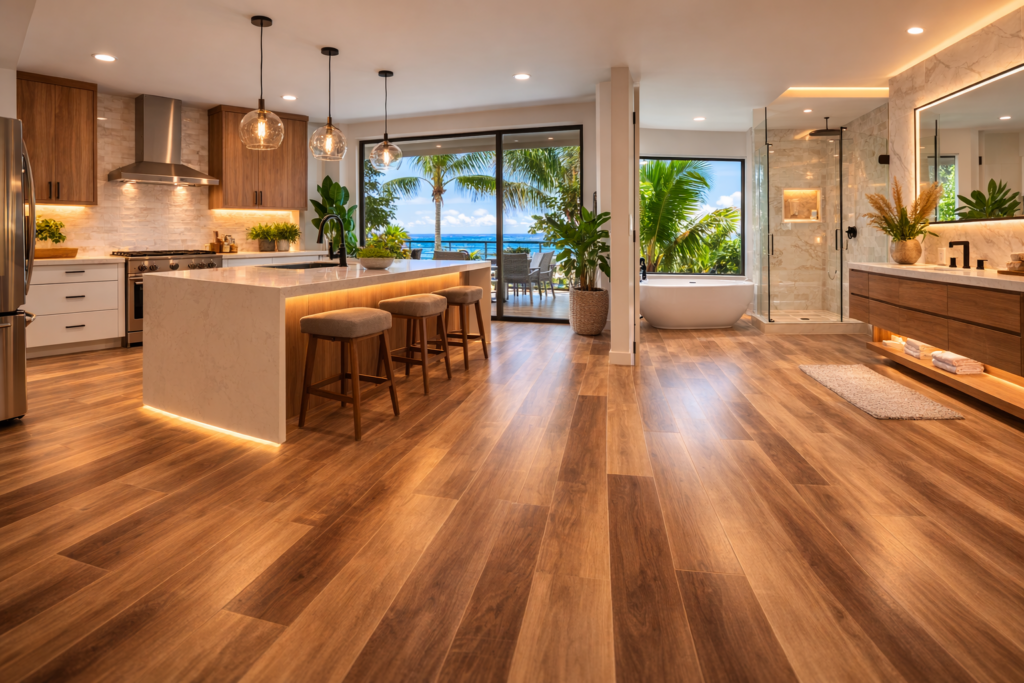
Walk into any newly renovated kitchen or bathroom in Honolulu right now, and there’s a good chance you’ll find luxury vinyl plank flooring underfoot. It looks like hardwood. It feels solid when you walk on it. And when you find out what it actually costs — and how well it holds up in Hawaii’s humidity — you start to understand why so many homeowners are choosing it over tile, stone, or real wood.
At VC Flooring & Stone, we’ve helped hundreds of Oahu homeowners transform their kitchens and bathrooms with quality flooring solutions. And time and again, luxury vinyl plank comes out on top — not just for its looks, but for the real-world performance it delivers in spaces that get wet, steamy, and heavily trafficked every single day.
If you’re renovating or simply tired of grout lines that won’t stay clean, this guide is for you.
What Exactly Is Luxury Vinyl Plank Flooring?
Luxury vinyl plank flooring — often abbreviated as LVP — is a multi-layer synthetic flooring product designed to replicate the look of natural wood or stone at a fraction of the cost. Unlike basic vinyl from decades past, today’s LVP is engineered with advanced technology that makes it thicker, more realistic in texture, and significantly more durable.
A quality plank typically consists of four layers: a wear layer on top that protects against scratches and scuffs, a printed design layer that mimics wood grain or stone texture, a rigid core (usually SPC — Stone Plastic Composite), and a backing layer for sound absorption and comfort underfoot. Our SPC vinyl at VC Flooring & Stone comes in 7.5mm thickness with a 20-mil wear layer, which is considered premium grade for residential use.
The result? A floor that looks and feels upscale, but can handle everything Hawaii throws at it.
Why Kitchens and Bathrooms Are the Perfect Match
Kitchens and bathrooms are the two most demanding rooms in any home. They deal with spills, splashes, steam, foot traffic, dropped items, and cleaning chemicals on a near-daily basis. That’s why the flooring you choose for these rooms matters more than anywhere else in the house.
Here’s why luxury vinyl plank flooring thrives in both spaces:
100% Waterproof Construction
This is the big one. Unlike hardwood — which warps and swells when it gets wet — or laminate, which can bubble at the seams, SPC luxury vinyl plank flooring is completely waterproof from top to bottom. You can mop it, splash it, or deal with a leaking dishwasher without panicking. In bathrooms, where moisture is constant, this is not just a convenience. It’s a necessity.
Built for Hawaii’s Humidity
Living on an island means dealing with humidity levels that would ruin most traditional flooring options. Hardwood absorbs moisture from the air itself and can gap, cup, or warp over time. Luxury vinyl plank, by contrast, is dimensionally stable — it doesn’t expand or contract significantly with changes in temperature and humidity. For Oahu homeowners, this stability is a major reason to choose LVP over other options.
Comfortable Underfoot
Tile is cold. Stone is hard. Hardwood can feel unforgiving after standing in the kitchen for an hour cooking a big meal. Luxury vinyl plank has a slight give to it — nothing dramatic, but enough that your feet and back notice the difference at the end of the day. With the attached underlayment most premium planks include, it also provides some insulation and sound absorption.
The Style Factor: It Actually Looks Beautiful
One of the biggest misconceptions people still have about vinyl flooring is that it looks cheap or fake. That was true 20 years ago. Modern luxury vinyl plank flooring has come a long way. The printing and embossing technology used today creates incredibly realistic wood grain textures, complete with natural-looking variation between planks. From across the room — or even up close — it’s genuinely difficult to tell it apart from real hardwood.
At our Honolulu showrooms, we carry a wide range of finishes — from warm, wide-plank oak looks to cool grey tones and even stone-inspired designs. Whether your kitchen leans contemporary or your bathroom has a more traditional feel, there’s an LVP option that fits. And because the planks run continuously across open spaces, they create a seamless visual flow that makes smaller rooms feel larger and more connected.
Easy Maintenance — Because Life Is Busy
Nobody wants to spend their weekend maintaining their floors. Grout lines in tile collect grime no matter how often you clean them. Hardwood needs refinishing every several years. Stone requires sealing. Luxury vinyl plank flooring, by contrast, is about as low-maintenance as flooring gets.
Day-to-day care is simple:
• Sweep or vacuum to remove dust and debris
• Damp mop with a gentle floor cleaner — no special products needed
• Wipe up spills when they happen — no rushing, no damage
• No waxing, no sealing, no refinishing — ever
For families with kids, pets, or just a lot going on, that kind of simplicity is genuinely life-changing. Your kitchen floor gets walked on a hundred times a day. Your bathroom floor deals with wet feet, hair products, and cleaning chemicals. LVP handles all of it without complaint.
Comparing LVP to Other Flooring Options
If you’re weighing your options, here’s an honest comparison of how luxury vinyl plank flooring stacks up against the most common alternatives for kitchens and bathrooms:
LVP vs. Ceramic or Porcelain Tile
Tile is durable, but it’s cold, hard, and grout-heavy. Installation costs more, and cracked tiles are difficult to replace without disrupting the whole area. LVP is warmer, more forgiving underfoot, easier to install, and individual planks can be replaced if needed. On cost, LVP typically comes in lower — both on material and labor.
LVP vs. Hardwood
Hardwood brings natural beauty, but it doesn’t belong in wet rooms. Even engineered hardwood — which has better moisture resistance than solid wood — is not recommended for bathrooms and requires careful care in kitchens. LVP delivers the same visual warmth with none of the moisture-related risk. It also tends to cost significantly less.
LVP vs. Laminate
Laminate looks similar to LVP but has a wood-composite core that is not fully waterproof. Exposure to standing water or high humidity can cause swelling, warping, and bubbling over time. In Hawaii, that’s a real concern. LVP’s stone-plastic composite core doesn’t have that vulnerability, making it the smarter choice for our climate.
What to Expect During Installation
One of the reasons luxury vinyl plank is popular with contractors and homeowners alike is that it’s relatively quick and clean to install. Most LVP products use a click-lock system, meaning planks snap together without nails or glue. This makes installation faster and cleaner than tile, and it also means individual planks can be removed and replaced if something goes wrong years down the line.
At VC Flooring & Stone, we partner with licensed local installers who understand Hawaii’s specific conditions — including the importance of allowing materials to acclimate properly before installation. A kitchen or bathroom floor can typically be completed in one day, with minimal disruption to your household.
During your free consultation at either of our Honolulu showrooms, we’ll walk you through the process from start to finish — measuring your space, helping you select the right finish, and coordinating installation on a schedule that works for you.
Ready to Upgrade Your Kitchen or Bathroom Floor?
Luxury vinyl plank flooring is one of the smartest investments you can make in your Honolulu home. It’s beautiful, practical, genuinely waterproof, and built to last through years of everyday island life — without demanding much in return.
Whether you’re starting a full kitchen remodel, refreshing a dated bathroom, or just tired of dealing with grout lines that refuse to stay clean, we’d love to help. Come see our samples in person, explore finishes that work with your existing cabinetry and countertops, and get a free quote with no pressure and no rush.