
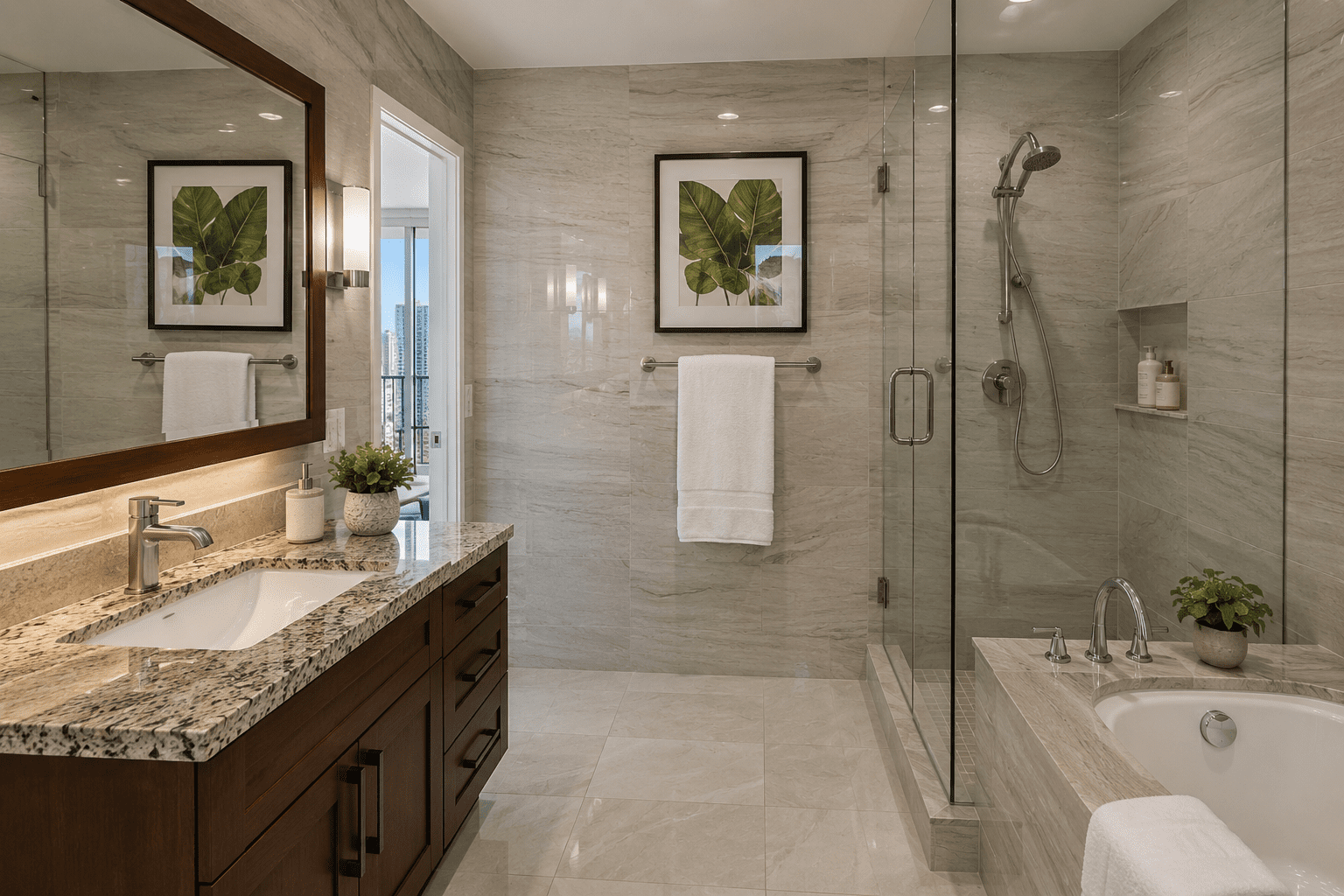
Quick take: A bathroom remodel in Hawaii lives or dies by three things: the right materials for island humidity, a realistic timeline, and a single team managing the moving parts. This guide walks through all three.
A bathroom remodel is one of the highest-impact upgrades you can make to your Hawaii home. Done well, it transforms your daily routine, raises long-term property value, and stands up to island humidity for decades. Done poorly, it becomes a recurring source of mildew, cracked grout, and warped cabinetry.
Below, you’ll find what to choose, how long to plan for, and how the Ohana Package folds the whole project under one roof.
Why a Bathroom Remodel Is Worth It in Hawaii
Bathrooms in Hawaiian homes work harder than bathrooms almost anywhere else. Salt air, year-round humidity, and constant moisture exposure age fixtures and finishes faster than they would on the mainland. That’s why a thoughtful bathroom remodel pays off here in ways it might not elsewhere.
National data from the NAHB Remodeling Market Index and the Houzz U.S. Renovation Trends Study consistently rank bathroom and kitchen renovations as the top two interior projects homeowners take on each year.
By the numbers:
- Roughly 1 in 10 U.S. homeowners renovate a kitchen each year (Houzz Kitchen Trends Study)
- Bathrooms rank as the #2 most-remodeled space behind kitchens
- A bathroom remodel typically returns 60% to 70% of its cost at resale (Remodeling Magazine Cost vs. Value)
- In Hawaii’s tight inventory market, well-executed renovations frequently outperform that benchmark
What Hawaii Homeowners Gain
Beyond resale value, a bathroom remodel in Hawaii delivers practical wins:
- Moisture-proof materials that resist mold and mildew
- Better ventilation to combat trade-wind humidity
- Stone and tile that ages gracefully in coastal conditions
- Energy-efficient fixtures that lower water and power usage
- Layouts designed for Hawaii’s indoor-outdoor lifestyle
Choosing the Right Materials for a Bathroom Remodel
Material choice makes or breaks a bathroom remodel in Hawaii. What looks great in a Phoenix or Denver showroom may not survive a year in Honolulu without warping, fading, or staining.
At a Glance: Best Materials for a Hawaii Bathroom Remodel
| Surface | Best Choices | What to Avoid |
|---|---|---|
| Floor | Porcelain tile, sealed natural stone, premium LVT | Untreated hardwood, low-grade laminate |
| Shower walls | Large-format porcelain, quartzite, sealed marble | Porous limestone, drywall-only finishes |
| Vanity countertop | Quartzite, granite, quartz | Soft soapstone, untreated marble |
| Cabinetry | Marine-grade plywood, sealed MDF, hardwood | Stock big-box plywood, particleboard |
Flooring That Survives Island Humidity
The floor is the workhorse of any bathroom remodel. We recommend porcelain tile, natural stone, or premium luxury vinyl tile (LVT) for nearly every Hawaii bathroom remodel we touch. Each option resists water, withstands sandy foot traffic, and pairs beautifully with the islands’ design vocabulary.
For a deeper comparison, see our Hawaii flooring guide.
Stone and Tile for Walls, Showers, and Vanities
Natural stone slabs (quartzite, marble, granite) bring warmth and authenticity to a bathroom remodel. Sealed properly and installed by a Hawaii-experienced crew, they perform beautifully for decades.
Porcelain large-format tile is another favorite, especially for walk-in showers, because it minimizes grout lines and the mildew that grout can attract. Browse our natural stone collection to see slabs we’ve personally vetted for Hawaii homes.
Cabinetry and Vanities That Won’t Warp
Stock plywood cabinetry from big-box stores often fails within a few years in island bathrooms.
For your bathroom remodel, look for:
- Marine-grade plywood
- Sealed MDF with moisture-resistant finishes
- Solid hardwood with a sealed top coat
- Soft-close hardware (now standard, dramatically extends life)
A Realistic Bathroom Remodel Timeline
Most homeowners underestimate how long a quality bathroom remodel takes. Setting realistic expectations from day one is the difference between an exciting project and a frustrating one.
Standard Project Phases
| Phase | Typical Duration |
|---|---|
| 1. Design & material selection | 2–4 weeks |
| 2. Permitting (if required) | 2–6 weeks |
| 3. Demolition | 1–3 days |
| 4. Rough plumbing & electrical | 3–7 days |
| 5. Tile, stone & flooring installation | 5–10 days |
| 6. Cabinetry, fixtures & finishes | 3–7 days |
| 7. Final inspection & punch list | 2–5 days |
Plan on 6–10 weeks total for a mid-range bathroom remodel and 10–16 weeks for a full primary suite renovation.
Why Hawaii Projects Take Longer
Container shipping, limited local trades, and county-specific permit timelines all stretch a bathroom remodel beyond mainland norms. The fix isn’t to rush the work. It’s to start sourcing materials early and work with a vendor that already keeps Hawaii-appropriate inventory on the islands.
How the Ohana Package Simplifies Your Bathroom Remodel
This is where most homeowners hit friction. Coordinating a designer, a stone yard, a flooring installer, and a general contractor on a tight island project usually means juggling four schedules, four timelines, and four opinions about what should happen next.
We built the Ohana Package to eliminate that friction. It bundles material selection, fabrication, and professional installation into one streamlined experience for homeowners taking on a bathroom remodel, or any flooring and stone upgrade across the home.
What the Ohana Package Includes
- Personalized design consultation with a Hawaii-based specialist
- Curated stone and tile selection from in-island inventory
- Precision fabrication in our local facility
- Professional installation by trained, in-house crews
- Project management from selection through final walkthrough
- One point of contact, with no chasing four different subcontractors
Why it matters: Bundling everything cuts weeks off most bathroom remodel projects and removes the most common cause of delays: handoffs between vendors who don’t talk to each other.
Who the Ohana Package Is For
The Ohana Package works for any homeowner who wants a streamlined bathroom remodel without sourcing materials, fabricators, and installers separately. We’ve delivered it for primary residences, vacation rentals, and full estate renovations across Oahu and the neighbor islands.
If you’re not sure whether your bathroom remodel fits, our team will scope your project at no cost. Reach out through our free consultation form and we’ll come back with a clear plan and timeline within a few business days.
Common Bathroom Remodel Mistakes to Avoid
Even careful homeowners trip over the same issues. Watch for these:
- Choosing finishes before measuring the space. Small bathrooms need different proportions than primary suites.
- Skipping the ventilation upgrade. Humidity destroys the most beautiful bathroom remodel within a few years if airflow isn’t addressed.
- Using mainland-spec materials. Porous stone, untreated wood, and certain grouts simply don’t last in Hawaii.
- Hiring four separate vendors. Every handoff is a delay risk; bundled services like the Ohana Package solve this.
- Underestimating lead times. Order tile, stone, and fixtures before demolition starts, not during.
A great bathroom remodel rewards planning. The homeowners happiest with their finished space tend to be the ones who slowed down at the design phase and let their installer help select materials.
A standard bathroom remodel in Hawaii usually takes 6 to 10 weeks from demolition to final walkthrough. Larger primary suite remodels can run 10 to 16 weeks. Material lead times to the islands often add 2–4 weeks compared to mainland projects.
Porcelain tile, sealed natural stone (quartzite, granite, certain marbles), and premium luxury vinyl tile all perform exceptionally well. Marine-grade plywood and properly finished hardwood are the best choices for vanities. Avoid untreated wood, low-grade laminate, and porous limestone in any humid bathroom remodel.
Cosmetic upgrades like paint, fixtures, and like-for-like replacements typically don’t require permits. Any bathroom remodel that moves plumbing, alters electrical, or changes the footprint will require county permits. Our team handles permitting as part of the Ohana Package. whenever it applies.
The Ohana Package is designed to flex. It works for a single bathroom remodel just as well as it does for whole-home flooring and stone projects. You only pay for what your project includes.
The fastest path is to schedule a consultation. Bring rough measurements, inspiration photos, and a wishlist. We’ll walk through material options, talk timelines, and give you a clear scope before any work begins.
Plan Your Bathroom Remodel With Confidence
A successful bathroom remodel in Hawaii comes down to three things:
- Choosing materials that survive island conditions
- Planning a realistic timeline
- Working with a team that handles the moving parts so you don’t have to
If you’re ready to take the next step, the Ohana Package is the simplest way to launch your bathroom remodel with a single team, a single timeline, and a single point of accountability.